
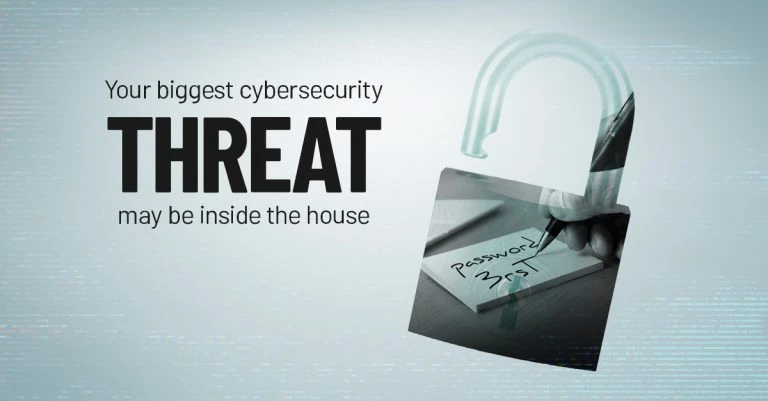
Your Biggest Cybersecurity Risk Could Already Be Inside Your Organization
Most businesses focus their cybersecurity efforts on external threats — hackers, ransomware gangs, and nation-state actors trying to break through the perimeter. But some of the most damaging breaches originate from within.
Employees, vendors, contractors, partners, and even executives can pose serious risks — whether through deliberate malicious action or simple human error. Recognizing the types of insider threats, spotting early warning signs, and knowing how to respond can mean the difference between a near miss and a catastrophic breach.
The 6 Types of Insider Threats
Insider threats take many forms. Here’s a breakdown of the most common:
 1. Data Theft
Occurs when someone inside your organization downloads, copies, or leaks sensitive information for personal gain or malicious purposes. This includes physically stealing devices or digitally exfiltrating confidential data.
2. Sabotage
A disgruntled employee, an activist, or someone acting on behalf of a competitor deliberately damages or disrupts your organization — by deleting critical files, infecting systems with malware, or locking you out of key platforms.
3. Unauthorized Access
Happens when an individual views or obtains information they have no legitimate business reason to access. This can be intentional or unintentional — some employees access sensitive data without realizing they shouldn’t.
4. Negligence and Human Error
Not all insider threats are malicious. Mishandled data, ignored security protocols, and avoidable mistakes can expose your business just as effectively as a bad actor with intent.
5. Credential Sharing
Sharing passwords — even with trusted colleagues — is the equivalent of handing your house keys to an acquaintance. You can’t control what happens next. Credential sharing opens the door to unauthorized access and increases your attack surface significantly.
6. Unauthorized AI Tool Use
Employees may use AI tools that haven’t been vetted or approved by your organization, inadvertently exposing sensitive company or customer data to third-party platforms.
Warning Signs to Watch For
Early detection is critical. Train your team to recognize these red flags:
- Unusual access patterns — An employee begins accessing confidential data unrelated to their role or outside of normal working hours.
- Excessive data transfers — Large volumes of data being downloaded or moved to external storage devices.
- Repeated authorization requests — Someone persistently requests access to systems or data their job responsibilities don’t require.
- Use of unapproved devices — Employees accessing confidential business data on personal laptops or unauthorized devices.
- Disabled security tools — Antivirus software, firewalls, or other security controls are turned off without authorization.
- Unauthorized AI tool use — Employees sharing sensitive data with public AI platforms or applications that haven’t been reviewed or approved.
- Behavioral changes — Missed deadlines, unusual secrecy, or visible signs of extreme stress can sometimes precede an insider incident.
No single indicator is proof of wrongdoing — but patterns matter. The earlier you identify them, the faster you can respond.
5 Steps to Build Your Defenses from the Inside Out
A strong internal security posture starts with these foundational steps:
- Enforce a strong password policy and require multi-factor authentication (MFA) across all critical systems and applications.
- Apply the principle of least privilege — ensure employees can only access the data and systems necessary for their specific roles. Review and update permissions regularly.
- Train your team on insider threat awareness, cybersecurity best practices, and the safe, responsible use of AI tools.
- Back up critical data regularly so your business can recover quickly from a data loss event — whether accidental or intentional.
- Develop a formal incident response plan that outlines how your organization will detect, contain, and recover from insider threat incidents, including clear guidelines for AI tool usage and data handling.
You Don’t Have to Fight Internal Threats Alone
Protecting your business from insider threats can feel like an overwhelming task — especially without the right tools, expertise, or team in place.
That’s where PDC Technology comes in. As an experienced IT and cybersecurity partner, we help businesses in Sacramento, El Dorado, and Placer County implement the security frameworks, monitoring solutions, and response plans needed to stay protected from the inside out. Whether you’re starting from scratch or looking to strengthen an existing program, we’re ready to help.
Ready to take the next step? Schedule a 15-minute discovery call and we’ll show you exactly how to detect potential threats and respond effectively if an incident occurs.